Is Inequity Inevitable in Capitalism?
Income disparity is skyrocketing in the United States leading many people, particularly millennials, to denounce capitalism as a failed system doomed to line the pockets of the rich at the expense of the poor. As Americans, we have a lot to be concerned about as it relates to our current version of capitalism. According to Opportunity Insights, if you are born in the United States, your zip code is a more of a predictor of your success than your substance, particularly if you are a person of color.
Capitalism is woven into the fabric of American ideals. We believe in freedom and opportunity. We believe that hard work should pay off. And we believe that a more cunning David can and should beat Goliath in a fair fight. We at CapEQ™ believe strongly in these American ideals, and in our minds, capitalism is the way to achieve them. But CapEQ™ is also dedicated to challenging assumptions and recognize our beliefs may not be aligned with reality.
The following three reasons highlight why we may have been deluding ourselves about the value of capitalism:
- American capitalism was not built on freedom.
One of my favorite quotes from the musical Hamilton is during the first Cabinet battle between Thomas Jefferson and Alexander Hamilton. Thomas Jefferson argues that the South shouldn’t share debt with other states because its debts are paid due to its economic prowess. Hamilton retorts
Your debts are paid cuz you don’t pay for labor, “We plant seeds in the South. We create.” Yeah, keep ranting. We know who’s really doing the planting.”
Now before you go eyerolling and thinking “oh Lord, not the slavery argument again”, let’s step back and think about the promise of capitalism. People work hard and companies pay for the value of their labor. They produce goods and services that other people want. The more people buy, the more profit a company earns. As profits grow opportunity expands for employees and the company. These aligned incentives produce mutual benefit for all involved.
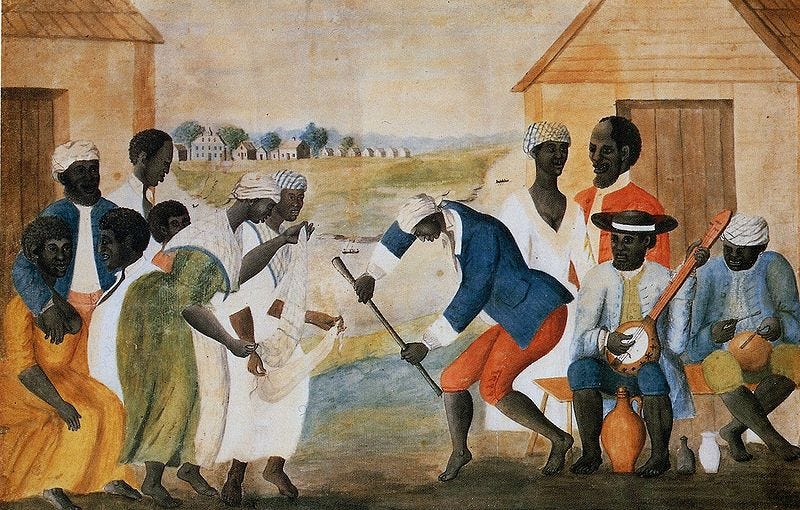
Even if we focus purely on the economic issues, one of the most egregious fallacies of American capitalism was slavery. Slave labor was not compensated for the up to $59 trillion owed to them. Enslaved Americans did not have the freedom to benefit from the goods they produced nor the resulting profit. This means that from day one, American capitalism violated the very tenets espoused by the system.
How did our young, scrappy, and hungry nation reconcile the sacred ideals of freedom with the atrocities associated with slavery? We invented and embraced the concept of “inferior” humans. Which leads me to the next truth about American capitalism.
2. American capitalism often denies opportunity.
Our country was founded on the belief that “all men are created equal”. This powerful and inspiring statement also upholds a dichotomy that undermines the principle. Every American is not included. Not even every American man is included. What’s most dangerous about this is it allows a belief in fairness and winning despite not everyone being able to participate, much less compete. And each generation, Americans pass on a belief to their children that they are winning because they earned it, because they worked hard, because they fought the good fight. What they do not acknowledge is that generation after generation they have a head start through unfairly accumulating wealth that assures them victory.
The lack of acknowledgement of this head start and the belief in fairness sets up American capitalism to continue to exclude humans considered “inferior”. For example, prior to World War II, Asian immigrants were recruited to the United States to farm for companies because they could not amass enough local labor to do the work. Chinese and Japanese farmers productively tilled the land. Despite the fact they were recruited for the value they could bring, they were not allowed to own land. They could not participate in amassing property and thus accumulated less wealth than their white counterparts. This had nothing to do with hard work. This is because American capitalism is guided by policies that determine which “men are created equal”. And it often has a net negative effect on people who were determined to be “inferior”. Which lands us at our last critique of American capitalism.
3. The fight is rigged against David.
During the Gilded Age of US history there were challenges with voter fraud, monopolies, and other forms of corruption and intimidation. The more wealth people amassed, the more they worked to keep it for themselves at the expense of others, even if it meant rigging the fight in their favor. As a result, income inequality skyrocketed to untenable levels. Once again, the labor who produced the goods and services was not earning the value they created. And who was the labor at this time? Immigrants, who were also considered “inferior” humans.
As a result, the US built guardrails around its capitalist system through a series of policies. These policies were an attempt to begin defining and refining the ideals of American capitalism. Policies that brought us back to the ideals of capitalism. Hard work should pay off. People should have fair competition. And the aligned incentives should yield mutual benefit for the employee, the consumer, and the company.
It is easy to think rigging the fight is an old school problem in the early days of American capitalism. But it’s not, and coupled with racist policies, the capitalist system has been rigged against working people and especially people of color since the country began — from slavery to Jim Crow to redlining to the GI Bill and the Social Security Act intentionally excluding people of color, to the Federal Highway Act and Urban Renewal intentionally destroying black communities.
It is important to note that capitalism, or most other systems and tools, are not inherently good or evil. These are all just tools for organizing a society and culture. What is more important than the tool is the people and the reasons why they wield them. And historically, despite our country’s ideals, we have wielded American capitalism with an underlying belief in human inferiority that has undermined the system and justified unfair practices.
Despite these warranted critiques of how capitalism has functioned in the US, we still have the opportunity to make capitalism function as it was intended. That is why CapEQ is so dedicated to the capitalist model and capitalist ideals. The beauty of the system is that when capitalism functions well it should result in mutual benefit. The idea that we can work together to better ourselves and others in fair and competitive trade is still worth fighting for.
We at CapEQ™ are very aware of capitalism’s failings, but we are equally as committed to intentionally addressing the inequities built into the system. Because there are many things that make capitalism a powerful tool for change, and our next article will share a few ways we can do just that!