When Business Steps Up: What Instacart Can Teach Us About Collective Action

When the federal government rolled back SNAP benefits, millions of families suddenly had less to spend on groceries. But as the policy change took effect, something interesting happened: several companies whose business models depend on food access stepped up.
Instacart, DoorDash, and GoPuff each launched promotions to help SNAP recipients stretch their dollars a little further. Instacart rolled out free delivery and discounts for qualifying customers. DoorDash offered reduced fees. GoPuff expanded its EBT-eligible grocery selection.
These weren’t just acts of goodwill. They were smart business moves rooted in an understanding that community well-being and company success are deeply connected. Plus, they highlight an increasingly urgent reality: in moments of disruption, the private sector can’t afford to sit back and wait for someone else to act.
Seeing the Strategy Behind the Action
These companies didn’t reinvent themselves overnight. They made one clear choice: Align community needs with business outcomes.
This is exactly the kind of decision-making the Good Business Worksheet is designed to support. It’s a practical tool I’ve used with leaders across sectors to help them understand where their business decisions — especially spending decisions — can drive both impact and value.
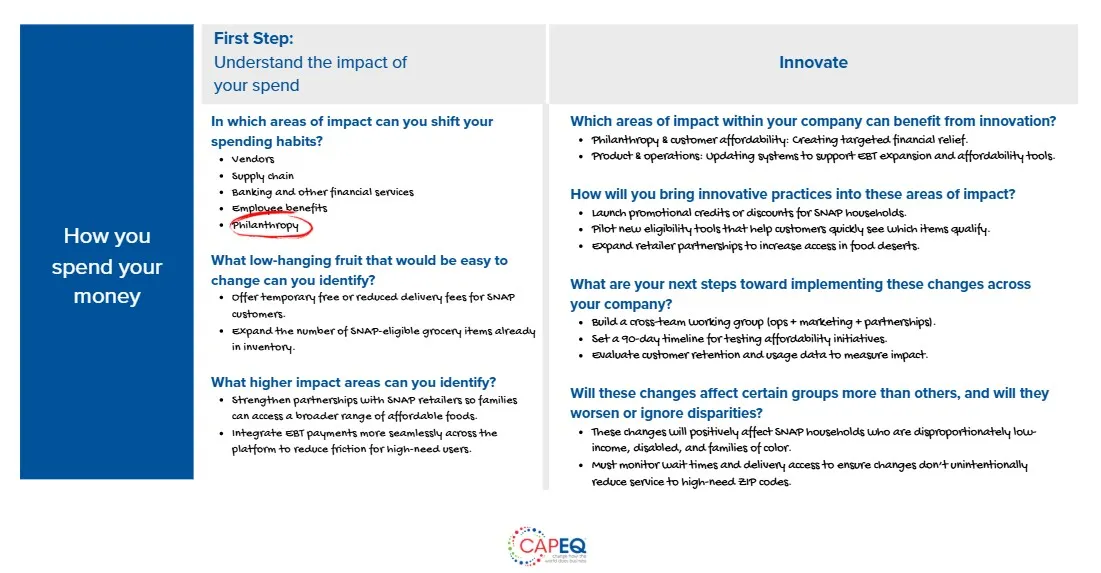
If we were to fill out the worksheet using the SNAP promotions example, it becomes obvious how philanthropy can be an innovation lever, not just a charitable gesture.
Here’s how the logic works:
- The need: SNAP reductions hit low-income consumers the hardest.
- The business reality: These families are core to the customer base for delivery and grocery platforms.
- The opportunity: A targeted philanthropic action (discounts, delivery fees, expanded eligibility) helps maintain access to food and supports continued engagement with the platform.
- The result: Stronger community outcomes and stronger customer loyalty.
This is what “spending with strategy” looks like.
A Simple Tool for a Complex Moment
We are operating in a moment where businesses are being asked to rethink their role in addressing social challenges. That can feel overwhelming, but the starting point doesn’t have to be.
Sometimes the first step is simply mapping how you spend your money today and asking: Where could a small innovation create a big difference for both my customers and my company?
If you want to see what that looks like in practice, here’s a filled-out slice of the Good Business Worksheet that mirrors what Instacart, DoorDash, and GoPuff just did. It’s a quick, concrete way to show how aligned spending decisions generate impact.
Now, explore the worksheet, try filling it out for your own organization, and see where your dollars could advance both your mission and your momentum.